RIG RESCUE 24/7 Mobile Truck & Trailer Repair 204-293-8382CALL

Roadside Truck Repair — Winnipeg · Kenora · Dryden · Hwy 17 WHERE IT QUITS. WE START.

Rig Rescue is a mobile truck and trailer repair crew based in Winnipeg. When a commercial unit goes down, a mechanic drives to it and works where it sits — no-starts, batteries and charging, electrical faults, air leaks, overheating, fuel gelling, tires, trailer lights and derate warnings. Repairs are carried out on site where feasible, across Winnipeg, Kenora, Dryden and the Highway 17 corridor.

Locate Me can read your phone's coordinates after you approve it. You review or adjust the pin first; nothing is sent until you choose Text Location.

Can't share location? Send a pin instead
  1. Open Google Maps.
  2. Press the blue dot showing your position.
  3. Choose Share.
  4. Text the pin to 204-293-8382.

If the unit is in an unsafe traffic position or anyone is injured, call 911 first. Move to a safe place only when it is safe and lawful to do so.

01 / DISPATCH

WHAT HAPPENS
AFTER YOU CALL.

  1. 01 / CALL

    “Where is it, what is it, what's it doing?”

    A mechanic picks up. Three answers are enough to start the run.

  2. 02 / ROLLING

    “The shop is already on the truck.”

    What you described decides what's in the back before the wheels turn.

  3. 03 / WEATHER

    “Rain doesn't get a vote.”

    The repair still happens where the truck stopped, not where it's convenient.

  4. 04 / WINTER

    “Gelled fuel. Dead batteries. Cold steel.”

    Winter here isn't an excuse — it's most of the callouts.

  5. 05 / ON SCENE

    “Now we find out — with a meter, not a guess.”

    Work lights up. The diagnosis happens at the truck.

02 / FIELD DIAGNOSIS

WHAT ROADSIDE TRUCK PROBLEMS
RIG RESCUE REPAIRS.

Ten systems the crew chases at the roadside. Pick the failure that matches your symptom — each one says plainly what gets checked and what the shoulder allows.

01 / FAULT

Won't start

Cranks slow, clicks once, or dead by morning

Field report

03 / FIELD REPORTS

WHAT GETS CHECKED.
WHAT THE SHOULDER ALLOWS.

01

No-start

“Clicks once and dies.” · “Cranks slow.” · “Dead by morning.”

Checked: voltage and connections, load and draw, starter response, alternator output.

Typically repaired at the roadside — boost first if that moves you, then the actual cause.

02

Battery, starting & charging

“Won't hold a charge.” · “New battery, same problem.”

Checked: battery condition, terminals and grounds, starter draw, charging output.

Typically repaired at the roadside — batteries, starters and alternators changed at the truck.

03

Truck & trailer electrical

“No lights on one side.” · “Blows the same fuse.” · “Gauges went dark.”

Checked: harness and grounds, fuses and relays, lighting circuits, power feeds.

Typically repaired at the roadside — tractor and trailer circuits traced on scene.

04

Air leaks & air system

“Hissing at the tanks.” · “Won't build air.” · “Drops overnight.”

Checked: lines and fittings, valves, leak isolation, build-up rate.

Typically repaired at the roadside — the leak is isolated and the system proven before you roll.

05

Brakes

“Brakes dragging.” · “Chamber blew.” · “Won't release.”

Checked: chambers and pots, slack and adjustment, air to the axle, what locked and why.

Roadside where feasible — heavier brake work is shop-scale, carried out where the truck is parked when the job allows.

06

Cooling & overheating

“Temp climbing on grades.” · “Coolant on the ground.”

Checked: leak source, hoses and clamps, coolant level and condition, fan operation.

Often repaired at the roadside — it depends what is leaking, and you get that answer at the truck.

07

Derate & DEF warnings

“Counting down to 5 MPH.” · “DEF light won't clear.”

Checked: codes read on scene, DEF system assessment, DPF and EGR service.

Assessed on scene — emissions service only. Emissions deletes are illegal and are never performed.

08

Trailer, lights & reefer

“No trailer lights.” · “Reefer threw a code.” · “No air to the box.”

Checked: trailer circuits and plug, lights, air to trailer, reefer faults.

Typically repaired at the roadside — the box gets fixed where it sits, tractor present or not.

09

Tire & wheel end

“Blew a steer.” · “Hub's hot.” · “Oil on the rim.”

Checked: tire condition, wheel seals, hub temperature and play.

Tires at the roadside — seals and hubs where conditions allow, with a straight answer either way.

10

Winter starting & fuel gelling

“Gelled up overnight.” · “Dies like it's starving.” · “Won't light off in the cold.”

Checked: gelling and filters, fuel supply, cold-start behaviour.

Typically repaired at the roadside — worked in the cold it happens in.
04 / ROADSIDE REPAIR CAPABILITY

FIXED WHERE IT SITS.
WHEN IT CAN BE.

MOVES ON THE SHOULDER

  • Boosts, batteries, starters, alternators
  • Air leaks — lines, fittings, valves
  • Truck and trailer electrical, lighting
  • Tires and tire changes
  • Fuel gelling and winter starting
  • Cooling leaks and overheat diagnosis
  • Derate and DEF warnings — read and assessed
  • Trailer repair, lights and reefer faults

NEEDS MORE THAN A SHOULDER

Some failures want a bay, parts on order, or heavier iron. That verdict comes from a mechanic at the truck — not from a guess over the phone — and you hear it straight, with a path forward. Rig Rescue does not tow; when a job needs a hook, we say so and refer you honestly.

THE VERDICT COMES FROM THE TRUCK, NOT THE PHONE — AND YOU HEAR IT ONCE, STRAIGHT, WITH A PATH FORWARD.

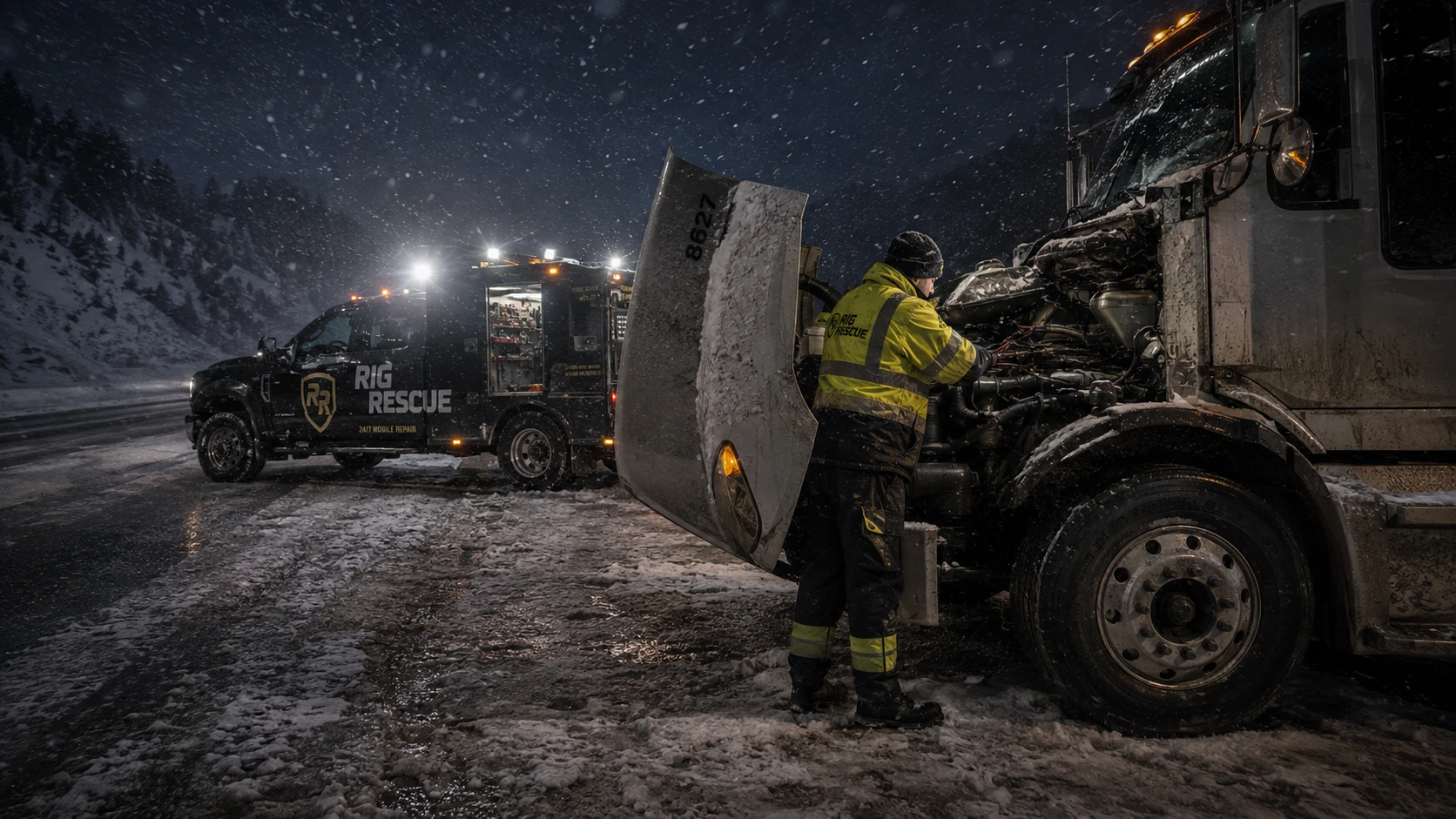
Illustrative winter roadside truck repair scene during snowfall.

WINTER / FIELD CONDITIONS

COLD DOESN'T MOVE THE TRUCK.
THE REPAIR STILL HAS TO.

Cold-start, battery and fuel-gelling problems are handled where the truck sits when conditions allow.

05 / THE LOAD-OUT

WHAT THE MECHANIC
BRINGS TO THE TRUCK.

Packed against your symptom before the wheels turn — not a generic van stock.

01 / DIAGNOSTIC

Scan tool

Reads fault codes at the truck, so the repair starts from evidence rather than assumption.

  1. Derate & DEF
  2. Electrical
  3. No-start
  4. Air system
  5. Wheel end
  6. Battery
  7. Overheating
  8. Trailer
  9. Tire

06 / HOW A ROADSIDE REPAIR IS CARRIED OUT

MEASURED. NOT GUESSED.

  1. F/01

    Secure the scene

    Lit, positioned, safe to work before a wrench moves.

  2. F/02

    Confirm the symptom

    Heard on the phone, proven at the truck.

  3. F/03

    Isolate the system

    The failing circuit, line or component — not the whole rig.

  4. F/04

    Test

    Voltage, pressure, temperature, codes. Numbers before conclusions.

  5. F/05

    Repair & verify

    Fixed where it sits, then proven — air holds, charge holds, temp holds.

  6. F/06

    The straight answer

    If the shoulder can't finish it, you hear that now — with a path, not a shrug.

07 / WHY IT'S DIFFERENT

ONE CALL.
NO RUNAROUND.

THE DIRECT LINE

  • The crew answers the phone
  • A mechanic makes the call
  • Roadside-first repair logic
  • A straight answer either way

THE RUNAROUND

  • A broker takes a message
  • Someone quotes sight-unseen
  • Tow-first by default
  • You wait to find out

08 / SERVICE AREA

WHERE RIG RESCUE PROVIDES
ROADSIDE TRUCK REPAIR.

Coverage is stated as named markets, never as a radius or a circle on a map. If you are on the route between them, call and you will get a straight answer about reaching you.

HOME MARKET

Winnipeg, MB

The base market. Mobile roadside repair across the city and the surrounding area — yards, docks, lots and the highways in and out.

ON CALL

Kenora, ON

No shop in town — a technician makes the run when you call, with the load-out picked against the symptom before leaving.

SERVED MARKET

Dryden, ON

The far end of the corridor, served the same way: the repair travels to the unit rather than the unit travelling to a shop.

THE CORRIDOR

Highway 17, Kenora to Dryden

The stretch that connects the markets above, and the one where a breakdown is least convenient. Rig Rescue is dispatched along it when called — no radius promises, no coverage circle, and no live tracking. Just the route, and a straight answer when you ring.

09 / THE HUMAN

THE PERSON
WHO SHOWS UP.

Not a call centre, not a subcontracted stranger. A working mechanic from a three-person Winnipeg crew, with the load-out picked for your failure and the authority to tell you the truth at the truck.

WHO ARRIVES
A working mechanic — load-out picked for your symptom
BASE
Winnipeg, MB
RANGE
Winnipeg — Kenora — Dryden — Hwy 17
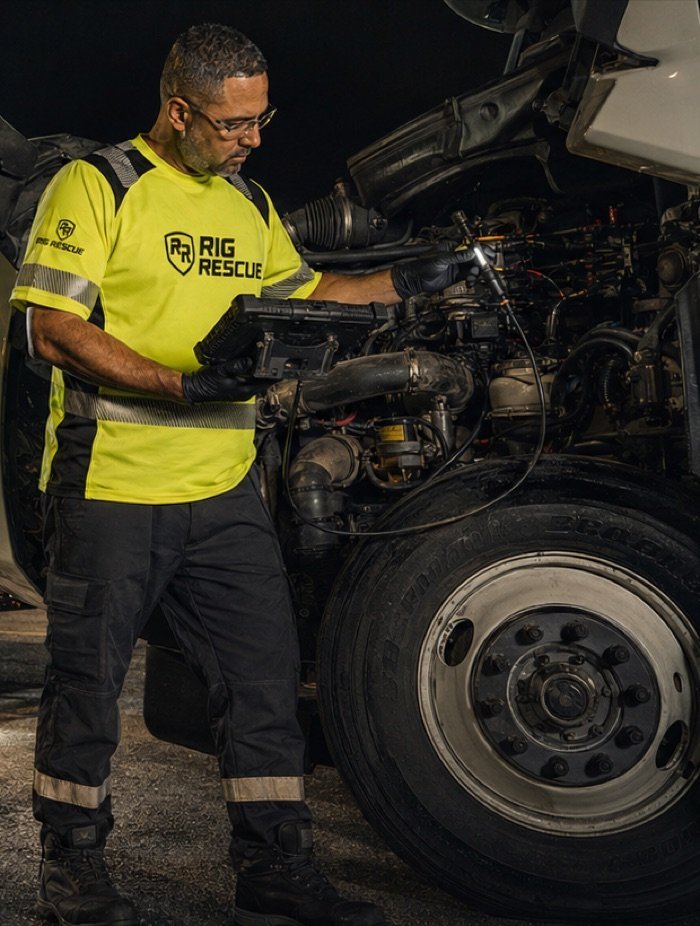
A technician in hi-vis reads a diagnostic tool at the open engine bay of a heavy truck at night.

08b / BY MARKET

WHERE YOU ARE
CHANGES THE CALL.

A callout in a Winnipeg yard and a callout on Highway 17 are not the same job. These pages explain what differs in each market.

10 / STRAIGHT ANSWERS

ROADSIDE REPAIR QUESTIONS,
ANSWERED.

What truck problems can Rig Rescue repair at the roadside?

Most no-starts, battery and charging faults, truck and trailer electrical, air leaks, cooling and overheating, fuel gelling, tires, trailer lights and reefer faults, and DEF or derate warnings. A mechanic diagnoses at the unit and repairs on site where feasible. Heavier work — brakes, wheel seals, suspension, clutch — is carried out where the truck is parked when the job allows it.

Can you help when a truck won't start?

Yes. A no-start is one of the most common calls. The mechanic boosts first if that gets you moving, then finds the actual cause — battery condition, connections and grounds, starter response or alternator output — and replaces what failed at the truck where the part and conditions allow.

Do you repair truck and trailer electrical problems?

Yes. Harness faults, grounds, fuses and relays, lighting circuits and power feeds on both the tractor and the trailer. Trailer lights and trailer circuits are a routine roadside call — describe the symptom, such as no lights on one side or a fuse that keeps blowing, and the mechanic traces it on scene.

Can an air leak be diagnosed and fixed on the shoulder?

Usually. Air lines, fittings and valve leaks are shoulder work: the leak gets isolated, the failed part replaced, and the system checked so it builds and holds before you roll. Larger brake and air-system work is shop-scale but can often still be done where the truck sits.

What about overheating or a cooling leak?

The mechanic finds the source — hoses, clamps, connections, coolant level and condition, fan operation — and repairs it on site when the failure allows. Some cooling failures need a bay. You get that answer at the truck rather than after a wait.

Can you help with a DEF light or a derate?

Yes. Codes are read on scene and the DEF system assessed, and DPF or EGR service is carried out. Rig Rescue performs emissions service only — emissions deletes are illegal and are never performed.

What should I have ready when I call?

Three things: where the unit sits — a highway marker, yard or dock address — what it is, and what it's doing. That is enough to pick the load-out against your symptom and start the run.

Do you provide towing?

No. Rig Rescue does not tow. The crew repairs on site where feasible, and when a job genuinely needs a hook you are told straight and referred to towing honestly. If a failure cannot be finished where it sits, you hear that at the scene from the mechanic who tested it, with a path forward.

Where does Rig Rescue provide roadside repair?

Winnipeg, Kenora, Dryden and the Highway 17 corridor between them. Coverage is stated as named markets rather than a radius — if you are on the route between them, call and you will get a straight answer about whether the crew can reach you.

FROM THE SHOULDER

DON'T WAIT
ON GUESSWORK.

204-293-8382

WINNIPEG · KENORA · DRYDEN · HWY 17 CORRIDOR

CALL WHAT WE FIX